
Monastery of the Holy Archangel Michael in Canones, NM

All Saints Autumn

Marshall

St. Francis III

Conor

St. Anthony

Vivian

St. Francis Christmas

Eleanor
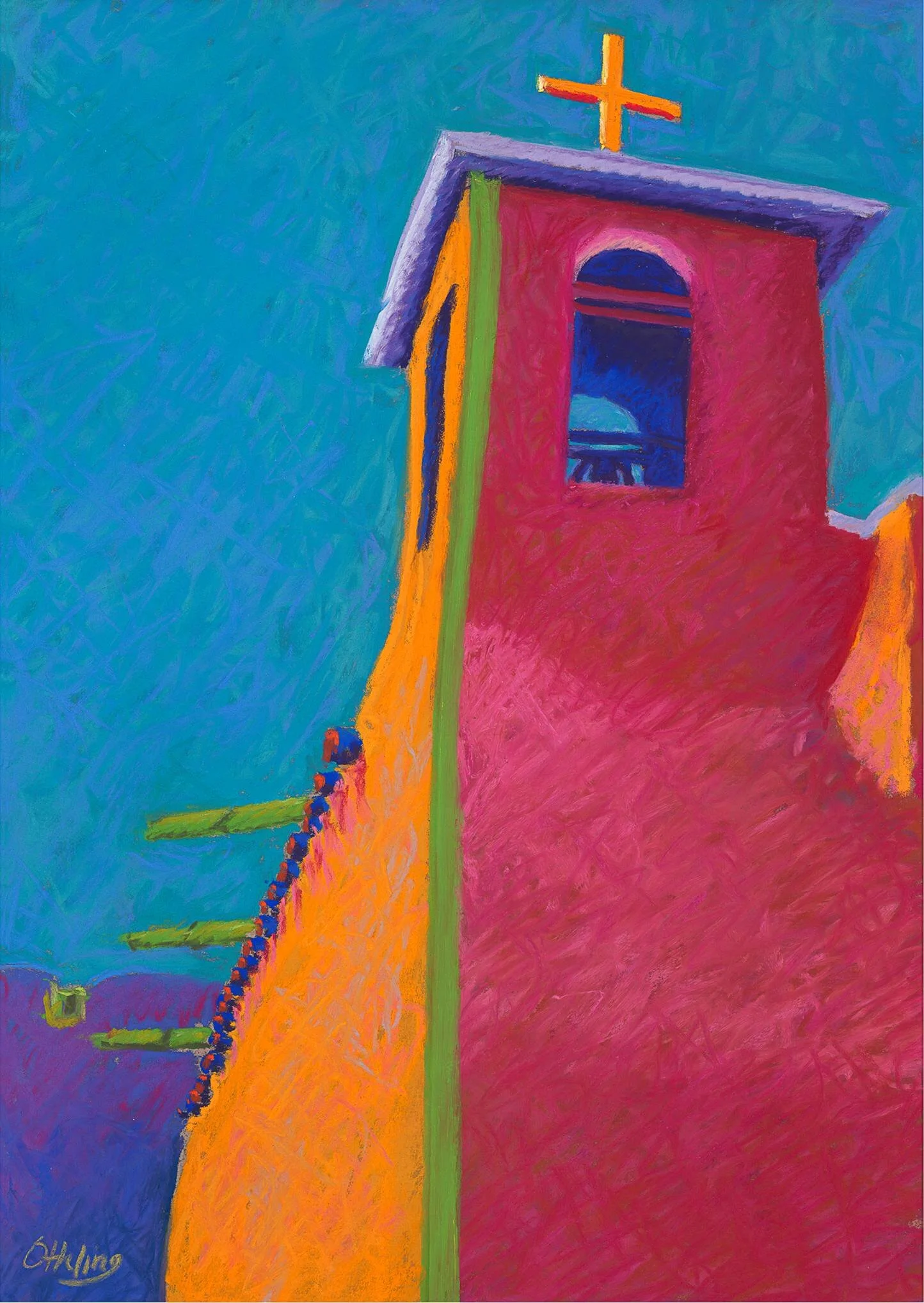
St Francis Bell Tower

James' Sunflower

Santa Cruz

Blake

San Ysidro

Sweet Pea

St. Augustine

Sunflower III

Morning Shadows

Sunflower II

San Luis Dome

Hollyhock Profusion
Rejoicing with Color: the essence of Terri Othling’s pastel paintings
The beauties of nature are the little loves that lead us to the great Love that is Christ.
Take delight in all things that surround us. All things teach us and lead us to God. All things animate and inanimate, the plants and the animals, the birds and the mountains, the sea and the sunset and the starry sky. They are little loves through which we attain to the great Love that is Christ. Flowers, for example, have their own grace: they teach us with their fragrance and with their magnificence. They speak to us of the love of God. They scatter their fragrance and their beauty on sinners and on the righteous.
+ Saint Porphyrios, Wounded by Love
You painted because you caught glimpses of Heaven in the earthly landscape.
+ C.S. Lewis
The visible world is actually colorless unless light is reflecting on it, which provides a trope for the notion that we are essentially colorless unless we reflect the light of God.
+ Karen Mulder
Why do two colors, put one next to the other, sing? Can one really explain this? no.
+ Pablo Picasso
Colour has me. That is the meaning of this happy hour. I and colour are one. I am a painter.
+ Paul Klee
There is not one blade of grass, there is no color in this world that is not intended to make us rejoice.
+ John Calvin
Of all God's gifts to the sighted man, color is holiest, the most divine, the most solemn.
+ John Ruskin

Pied Beauty
Glory be to God for dappled things – For skies of couple-colour as a brinded cow;
For rose-moles all in stipple upon trout that swim;
Fresh-firecoal chestnut-falls; finches’ wings;
Landscape plotted and pieced – fold, fallow, and plough;
And áll trádes, their gear and tackle and trim.
All things counter, original, spare, strange; Whatever is fickle, freckled (who knows how?)
With swift, slow; sweet, sour; adazzle, dim; He fathers-forth whose beauty is past change:
Praise him.
+ Gerard Manley Hopkins
I cannot pretend to feel impartial about the colours. I rejoice with the brilliant ones, and am genuinely sorry for the poor browns. When I get to heaven I mean to spend a considerable portion of my first million years in painting, and so get to the bottom of the subject. But then I shall require a still more joyous palette than I get here below. I expect orange and vermillion will be the darkest, dullest colours upon it, and beyond them there will be a whole range of wonderful new colours which will delight the celestial eye.
+ Winston Churchill